


Our starting point in understanding ‘self-organisation’ is rooted in a desire to start working from a sense of impulse rather than provision. It’s not just that we can ‘do it ourselves’, but instead, left to our own devices, structures, we can begin to work together. You begin to organise yourself alone and together with others. The shared pleasure and freedom that emerge are contingent on a struggle for survival; what empowers you one day, on the next reminds you that there is no other option. Rather than being defined as an alternative, repair or ethical supplement to existing structures, self-organisation is the successor of the dominant institutional models.
Caught in contradiction between both an affirmation and displacement of the dominant order the actual difference between self-organisation/self-management/self-care/self-help and any number of other self- words is slippery. The urge to self organise comes as both a neccesity for survival within capitalism (to do lists, organising space, time, money) and as part of the urgent need to realise other economies outside of the capitalist production paradigm.
Friendship becomes a necessary moment of the political. Could friendship be a form of production? Could cooperation also be a form of friendship? What do these communities look like? A liberatory care practice is one in which we move beyond self-care into caring for each other, and we can start by pointing at friendship as the core support for a better way of living.
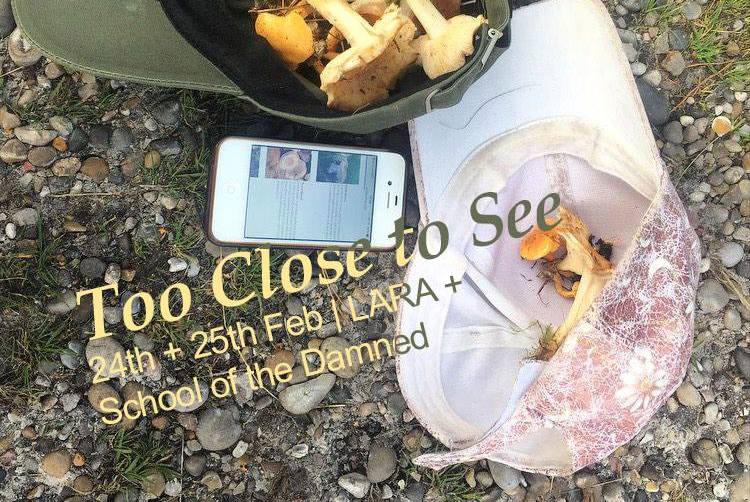
:LARA and School of the Damned
Thinking about:
Hindrances to futurity…?
Brief intro:
Online and print discussions about artist-led projects, and ‘culture’
Perhaps some of the most productive ways of thinking about the artist led for us does not necessarily involve gallery spaces or exhibitions per se, but things like private reading groups in people’s homes, (Hannah Regel), or utterly solitary singing practices.
Interest in engaging practitioners and spaces in this conversation
-
Publications sent to AL spaces
-
Events and discussions in AL spaces
-
Mapping
Psychological oppressiveness of the canon of
the artist-led - what is artist-led and what isn’t?
How do we internally police these borders? How determined is this definition by institutions, magazines, online debate...Is there an uncomfortable question of taste, mirroring, hierarchy, emulation, safety?
Does this afford you more friends? (What is the relation between friendship, contacts, and the desire for inclusion?)
Criticism
Notion of friendship, where does antagonism reside, can it exist or does ‘friendship’ quash it (Harry Meadley’s response to The White Pube during KFC-gate).
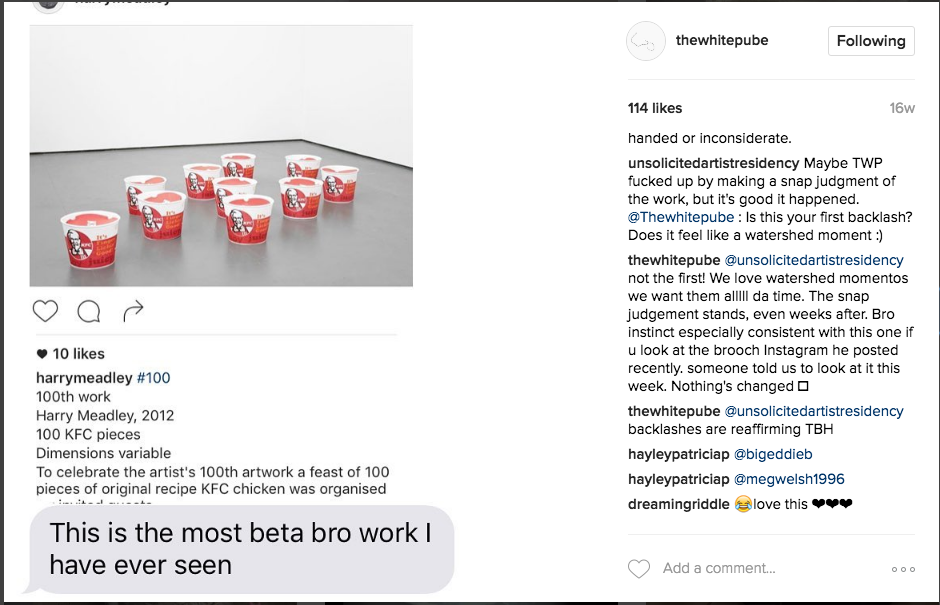
Can a good critic have any friends?
Demands a very generous form of non-hierarchical, non-defensive subjectivity?
This criticism has to exist, my immediate response is as legitimate as my considered one.
Is London conducive to keeping friends?
Disparate communities
Spatial dislocation of galleries
How long do we carry distinctions of regional /capital university/ education?
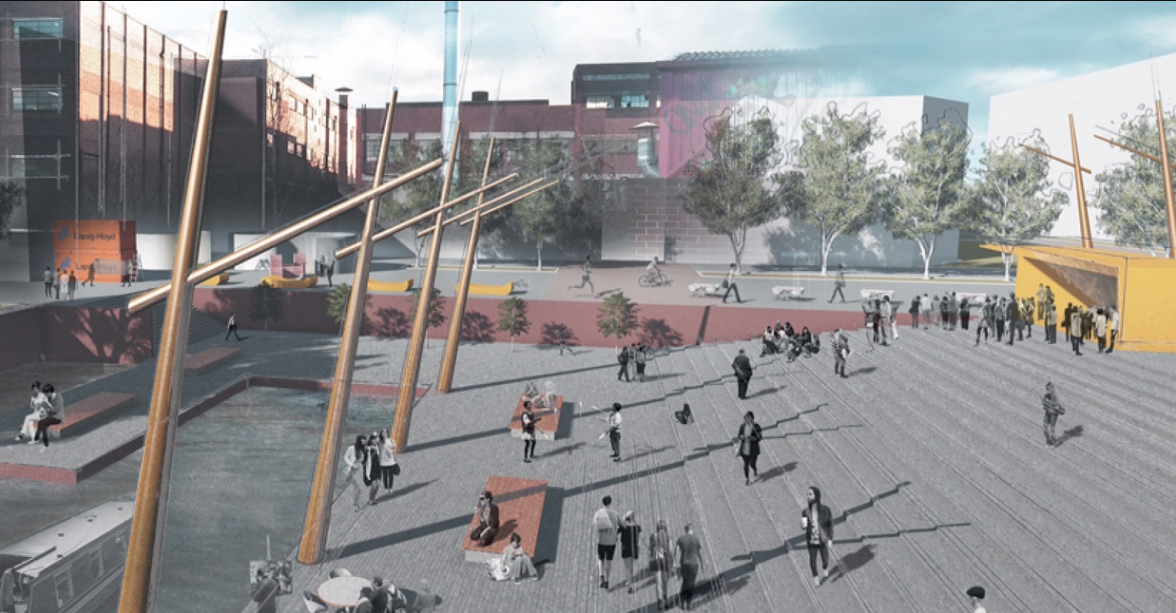
Scale of project as means to categorise the artist-led? Eastside Projects are currently developing a sister project with Birmingham University which had £14 million of government money put aside for it recently. Similarly S1 is expanding into a building which will cost somewhere in the region of £25 million of public money.
To bedroom / domestic spaces like Ladette Space or Celine in Glasgow
Living in scarcity
Could need/lack/excess be a useful categories of delineation? Doggerland was set-up initially with the intention that we would exclusively give space to reviewing and advocating projects without an advertising budget
conservatism with a small c
Formulaic exhibition model as means of stability of a project (Outpost as emblematic), or aridity? Various forms of rolling committee - is it an apprenticeship or a means to procure novelty through the naivety of youth?
Rolling committee’s
Outpost - weird how public identity has never really changed considering structure (yellow website, 10 solo exhibitions a year, plus a members show)
Royal Standard - ‘not a need to relearn the wheel’ / mistakes to be made again / jeopardise its legacy.
GeneratorProjects - invested interests from ex members. Nightmare administration
Is it easier to secure funding if you embody a professionalised conduct akin to a bigger, or commercial art gallery or museum. To what degree are these styles of presentation embodied unquestionably to join/assimilate within the canon?
Profit/not-for-profit - are these useful distinctions within the artist-led? Too binary? Perhaps more important question around what you do with that profit after you’ve procured it, and in turn how you conduct yourself as a not-for-profit. (Not-for-profit organisations can be meat puppets too.)
Profit generation, profit accumulation, profit purging
Kate Rich, (Cube Cola, Feral Trade) - “Where else is better to reformulate relationships towards capital than within the artist-led?” There is both less, and at the same time more at stake - with less resources to work with, those resources mean more
- Robin Hood Cooperative, a cooperative hedge fund that uses an algorithm (‘The Parasite’) to play the stock market, last checked their portfolio was worth over £300,000, they regularly use profits to fund anti-capitalist/commons research projects, usually around technology, but also art
Specific art co-op?
De/centralized funding pot, financed by those who are actively participating and producing, researching or engaging in AL culture. Shareholders have agency in selecting proposals, and proposals can only be submitted by those who contribute to the finance of the co-op funding pot. In turn, co-op investors are given incentives( … ).
Real-life barrier/s:
the recurrence of investment from the backers.
The loan return to the funding pot, how much interest?
Maintaining real democratic selection process
The co/ownership of property/land
Claims agency that is reduced by ACE applications. Not dependent on the Treasury announcements, Autumn Statements, Government accountability, or equating value of creative sector as an economic investment to national GDP, jobs sector, or well-being. Application process can be reformed in order to bypass speculative management or speculative audience engagement and/or benefits, it can have none. Perhaps more achievable if ever there were to be a UBI or GBI scheme rolled out across the country.
Property ownership - The Cube (and it’s community lands trust constitution?), Islington Mill
Rootlessness / couchsurfing
Nomadic/peripatetic practices
- http://www.seizeprojects.com/
- freedom of movement is predicated on another person's responsibility, i.e. one can only gain
short term rental of a property usually because it is under the banner of someone else’s long-term contract
- similarly a network of spaces could be formulated, partnerships built instead of antagonistic relationship of unequal responsibilities
Anna Clawson & Nicole Ward’s KITE network is a small example of this with a huge of amount of potential:
“We’ve been in touch with a few potential hosts, but it’s been quite difficult to convince them to join, they tend to clam up at the thought of commitment...As a platform I think it’s potentially pretty interesting, as an opportunity for finding out about each space’s community...I think people are fearful of something so simple though. It’s difficult in the arts, we’re taught to be a certain way, to be cautious, but people need to learn to be more open.”
Parasitic model - Anne Duffau’s ‘A-Z’ could be argued to be a legitimate instance of the artist-led intercepting the space of the institute relatively comfortably (as opposed to the other way around), content of her programming consistent throughout
Mapping
Doggerland map
Problems of homogenising ‘artist-led spaces’
Does not account for nomadic/roaming projects currently
How to map ghost spaces, not operating anymore
https://www.dublininquirer.com/2016/12/06/owns-vacant-derelict-dublin-mapped/
It’s potential limits as a tool when put into action, the amount of resources required to even create the map
Who or what type of organisation has enough authority/resources to capitalise on vacant properties?
Create - Rabbit Roads Institute, Open School East
BEEF? (Bristol Expanded Experimental Film)
Mapping/POLITICS
“...contemporary art, by supporting works and projects that are politically engaged, could step in where the culture industry and news media have failed. That is to say, the means by which art is analysed, disseminated and discussed (ie essays, events, exhibitions and talks) could be used to inform, empower and support the public by presenting and elucidating the subject matter of works dealing with contemporary socio-cultural and political realities that through bias, oversight or lack of interest are not presented elsewhere. At least that could be the reality if an appetite for such a move existed amongst arts professionals who determine institutional operations and output.” - Morgan Quaintance, Rules of Engagement, Art Monthly Oct 2016
-
What if said contemporary art or organisation does not represent a politics that is assumedly the dominant position of arts communities, progressive, left-liberal, socialist...LD50 gallery outed as pro-right, ‘fascist’ gallery.
http://horriblegif.com/post/157189463814/level-drama-50
http://www.metamute.org/editorial/articles/it-ok-to-punch-nazi-art-gallery - 16 Feb
Assumed politics? LD50-gate on a gallery-level, KFC-gate on an interpersonal artist-to-artist level
Idealised network of artist-led spaces, we assume everyone is inherently working towards the good of the arts
Spaces of the future not apolitical - what would that look like?
Is the Political only possible in artist-led?
Since the heyday of political art was snuffed out by formalism, aestheticism, the art market, the professionalization of art, critical art’s accelerated incorporation by big state museums and funding bodies, the institutionalization of institutional critique,…artists writers and curators have been at pains to distance themselves from the naïve practices of political art.
Political art cannot be political if it leaves art’s values, categories and institutions in place.
The institutional affirmation of critical art is the most efficient way of sabotaging it.
Social Agency
‘Our socialist conception of how art must be transformed does not start off with the idea of people as individual beings isolated, separated from others (e.g., artist, viewer, critic, curator), but with the idea of people as social beings, who can only develop themselves if they develop together with others (eg publics, collectives). Freee art collective
French philosopher Henri Lefebvre understood, there is no such thing as an abstract citizen, someone who is above everything, who is neither rich nor poor, neither young nor old, who is not gendered, or is all of those things at once. Miodrag Zecevic: “What exist are concrete persons who live amongst and depend on other people who associate with and organize in various ways with other people in communities and organisations in which and through they make real their interests, rights and duties.” –
Q: What does AL provide socially, when energies are invested in the revenue share of selling artworks. Are there examples whereby the conduct of the organisation or project emulates the conditions of commercial interests and the art market, without being much more than an antiquated vessel or conduit, a necessary portfolio process for emerging contemporary artists?
The notion of moving away from state paternalism to popular protagonism: from asking for something (ie capital), to taking control and fighting for something (better funding distribution), citizen governance.
…artworld must be built on the blossoming of “self-management, cooperatives of all kinds…other forms of association that are guide by the values of mutual cooperation and solidarity.”
Tenancy agreements - squatter rights
Group structure, board of trustees, etc.
Participatory democracy - ordinary people taking part in decisions about the issues that affect them. Porto Alegre in Brazil, since 1989, around 50,000 people have participated in annual debates about how to spend the city’s money. ‘Citizens realised that they were dealing with other people, whose concerns were basically the same as their own.’
New York City - city council members are employing participatory democratic methods to decide how to allocate discretionary budget grants for their neighbourhoods. Residents are invited to discuss how the money - normally couple million dollars $$ - is spent; schools, parks, transport etc. political labels seemed immediately specious.
Inclusive spaces
Radical generosity, radical hospitality
The use of the term artist-led. Which commercial ventures employ the term to describe themselves, and what are the implications of this?
Studio Voltaire? turnover is 600k with 40k profits: http://www.192.com/atoz/financial/business/03426509/
Criticality -
Longevity - both on horizontal (time) and vertical (developmental) axis
Pace - ‘Slow progress always seemed to belong to the reformists at the moderate end of the Left, while the call for a sudden, fatal blow to the system was seen as the calling card of the far Left….
Marta Harnecker argues, by distinction, that we should not judge politics on its pace but rather in terms of the direction it is taking. This shift from pace to programme is typical of “twenty-first century socialism”.
Pace within the artist-led. We can talk about the pace of Doggerland. It’s stop, start nature. Negative associations, but what in turn does this offer?
See also: Growth/anti-growth
Education
Celestin Freinet - “established Modern School Movement in 1926, by the time of his death in 1966 it involved 10,000 schools in 33 countries. He developed three complimentary teaching techniques: (1) the ‘learning walk’, during which pupils would join him in exploratory walks around town, gathering information and impressions about their community (a pedagogical application of the derive). Afterwards, the children would collectively dictate a ‘free text’, which might lead to ‘pretexts’ for direct action within their community to improve living conditions (local councils were particularly wary of Freinet’s pupils); (2) a classroom printing press, for producing multiple copies of their pupils’ writings and a newspaper to be distributed to their families, friends and other schools; (3) interschool networks: pupils from two different schools exchange ‘culture packages’, printed texts, letters, tapes, photographs, maps, etc. Several of these twinned schools would then join to form a ‘cluster’, in an effort to represent as many national regions and countries as possible, leading to global learning networks especially useful for foreign a language teaching.” (Footnote in Guattari’s ‘The Three Ecologies’)
Has this been coopted and marketised by Apple? “Talent-based-learning”. People of Low-income communities and students are given a generic problem to solve, like conserving energy. This is then applied to the relative context of their environment, and presented back to the community, to be considered and implemented.
Reference to educational model: PZI
Embracing inquiry – Huib Haye van der Wert, art and education
http://www.artandeducation.net/school_watch/embracing-inquiry-at-the-piet-zwart-institute-master-of-fine-art/
‘Deschooling/Deskilling’ –
Vivian Sky Rehberg: “Educational turns and drives can and do flourish in informal settings and outside of schools. Many of today’s pedagogical experiments are socially and politically motivated and come with an explicit or implicit critique of the expansion of a neoliberal market for education supported in Europe by continental policy and university administrations alike. As a response, alternative educational structures and platforms stress more open access and appeal to broader audiences via the reduction or absence of fees, voluntary teaching and learning, and the freedom that comes with the rejection of a predetermined curriculum, learning outcomes, criteria assessment and the need for quality assurances. All of which are a necessary feature of accreditation requirements for degree-granting programs worldwide.
“emphasizes independent learning, research, and communication, and stresses the complexity and scope of issues raised in and by artworks. Research, defined simply as studious enquiry, is a key element of the curriculum.”
Thierry de Duve, “the métier gets practiced, the medium gets questioned. The métier gets transmitted, the medium communicates or gets communicated. The métier gets learned, the medium gets discovered.”
‘good habits’ - what an artist needs to sustain a practice
Bernd Krauss on PZI research trip: “It’s more an economy than a pedagogical ideology,” Krauß said. “It’s about understanding your responsibility to making work and constantly reclaiming your autonomy.”
Opportunities to change the direction of the course into a more streamlined and homogeneous program have revealed themselves over the past years, yet the continuity of community and conversation has triumphed. Art practice and its education as an open subject, communicated in a human environment has been the lasting result.
‘They would be delinked from the debt economy and sustained through mutual aid, and cooperative systems of production of exchange. They would be able to tactically siphon and collectivise resources from arts, academia, even philanthropy while in the process of building a new society in the shell of the old. They would deconstruct the opposition between urban and rural in order to build an infrastructure of the commons, with questions of land and territory at its heart. Acquiring campuses for such institutions could involve any means necessary, from illegal occupations to agreements with churches or farms, or indeed a land jubilee that would purchase land and protect it from the market in the form of democratically run land trusts.’ - Yates McKee Transitional apparatuses (e.g. The Cube, Bristol)
Re-distributing wealth - contracts?
Independence - how should we relate to institutions (proto, anti or para-institutional)? How should we engage with public funding (tragedy of the commons)?
Fear - Its uses (wobbly chair) and abuses (an anxiety that erodes joy)
Dethroning capitalism - alternative ways of engaging with value outside of the monetary?
Growth/anti-growth - reproductive futurism (idealisation of the child as the ultimate emblem of futurity) & the limitations of presuming growth as the only form of production/becoming - WHY PUBLICISE ANYTHING? Is a museum show the end goal?
Fetishisation of the small as authentic, and the power of local communities is often totally overestimated. Decentralisation is on the whole a good thing, affording people affected by policies to orchestrate what works for them/the majority. But ability of the small organisation or collective is limited in face of wider, national legislation or big companies/ property developers.
Exhibition models - does the private view still work as the main context in which to view contemporary art? What can we carry forward from it? What could we trim? The social function of the private view... How do we collectively live with art?
Artwork-centred perspective (riffing on plant-centred farming)
“Attention is the rarest and purest form of generosity” - Simone Weil, ‘First & Last Notebooks’ ...and surely that is exactly what artworks want from us
Keep things complex - http://makeitclear.eu/
Artists Union
Social mobility within arts sector, create, guardian, goldsmiths, - http://createlondon.org/event/panic-what-happened-to-social-mobility-in-the-arts/
Buy a boat?! A space not landlocked. Maybe use Patreon for the mooring fees…
‘Future Proof: Britain in the 2020s’ - paper published by centre-left think-tank IPPR - predict that ⅔’s of labour is at risk of automation by the end of the 2020’s, in particular this is any job that is in any way repetitive, i.e. most precarious, low-waged labour - (they point to carework, service industry, and teaching) all work that can often form part of an artists income outside of, or absolutely sustaining, their practice.
Sustainable materialism in the midst of the anthropocene - how to make exhibitions in the context of ⅖ of population looking to be living in state of water drought by end of 2020’s, and an estimated 60-100 harvests left on this planet (as a result of soil degradation)? (Note to self - the internet/the digital are not immaterial just because they aren't visible)
Hydration
Warm, comfy spaces / sofas
“a growing body of international evidence suggests that farming on a smaller scale is more productive per acre in terms of yield, profit and other social and environmental benefits, including biodiversity” (Ecological Land Co-operative’s report ‘Small is Successful’) - can a similar argument be made for the artist-led against larger-scale institutes? Similar, to what extent should we (as a heavily invested body of producers and audience) hold these larger institutes to account for their use of public spending