



Doggerland were invited by Bristol Biennial to act as intermediaries for the 2016 In Other Worlds festival, to open up a space for critical thought and conversation. Developed through a dialogue with BB on the problematics of commissioned writing producing open and critical responses to its subject, we invited 4 local practitioners and writers to submit anonymous reviews on an aspect of the festival of their choosing.
I am not a plastic cup
Available on the market today are a variety of biodegradable disposable catering goods: Vegware and Compost Me, to name but a few. These alternatives are positioned on the market as a solution to the damaging levels of plastic waste resulting from contemporary lifestyle. The Compost Me cups are decorated with the tag line ‘I am not a plastic cup’. It points out the ingenuity of the object, its successful imitation and superiority to its rival/predecessor and the tantalising promise of a solution to a global waste crisis.
These biodegradable cups/containers/spoons require industrial intervention for said compost to be realised. In the UK there is limited access to this machinery and in the city of Bristol none, meaning as a non-recyclable product all the good intentions of this innovative technology go straight to landfill.
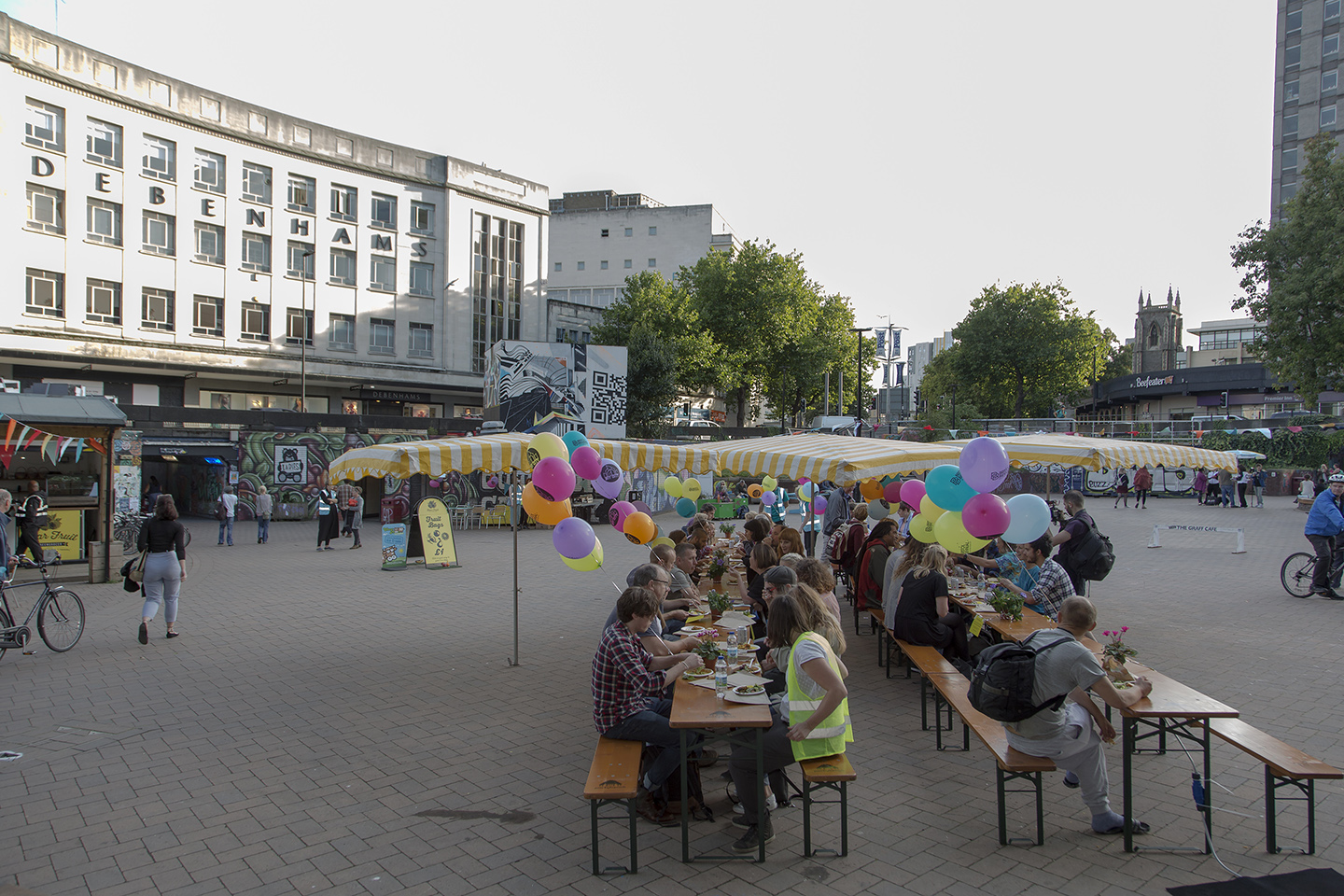
BB’s 2016 edition ‘In Other Worlds’ began with an opening celebration, ‘Bearpit Banquet’, a banquet held in ‘one of Bristol’s most contested public spaces’. The bearpit is a well trodden intersection between Bristol districts, it is also, in equal measure, a popular site for street drinking, begging and busking. BB’s use of this space is, as stated by them, an opportunity to ‘create a new community together’. From the outside it looks as you might expect, there is a banquet table, a place for speeches, a food vendor and bunting. Your £5.00 meal ticket, covers your meal and makes a contribution to a meal for someone who may not be able to pay. Hosting an opening banquet in a public space such as this cannot be read as anything but political. Through this prism this scenario becomes, at worst, a celebration of the gentrification of a collectively owned and uncontrolled space of dissidence, or, at best, an uncomfortable image of a group of intelligentsia attempting to break down complex social barriers rooted in conflicting levels of privilege.
The opening aside, what is noticeable from BB’s program is that all works sited in the city are outside of the conventions of the gallery, and you can presuppose that how art ‘relates’ to the place it is situated in and which demographic of society bares witness is the priority here. The overview of the program (viewed online) includes ‘DIY city’, consisting of public consultations led by artists; ‘Better than I imagined’, art therapy for volunteers; and works that reference climate change, the future of the city, new models of working together, all illustrating a clear social conscience behind the festivals direction. In reality though, the materialisation creates a similar disconnect to ‘I am not a plastic cup’. It has a good label, but the original intentions are problematically realised. A workshop for volunteers designed to enable reflection on the experience of being unpaid does not ameliorate the usage of unpaid labour in the first place, if anything it presents an uncomfortable coping strategy for the continued use of this labour, and as an item of the festival itself spotlights the appropriation of the ‘voluntary contribution’ both as hidden labour and as content. The banquets chosen location does not have a clear narrative unpicking some of the more complex challenges faced when using it in this way. This is an unfortunate thread that runs through the program itself, the topics so weighty that it is an over ambitious task to create a response that does not fall into the category of a token act, despite all the hard work and visible good intentions behind it.
Art Spin
As a newcomer to the Bristol Biennial, I was excited at the prospect of experiencing an event which mirrored the significance of the name alone. The artistic ownership of a ‘Biennial’ gave me a great sense of anticipation for what to expect...rebellion, activism, or a politically motivated critique of contemporary culture.
Appearing highly participatory, it seemed the best way for me to engage with the biennial was through Art Spin. This three hour cycle-led tour across the city allowed me (and about 50 others) to encounter three of the festival’s most prominent sites. With a fantastic team of volunteers coordinating and triggering an infectious bout of bell-ringing, the activity felt good natured and very inclusive. The whole journey proved to be a smoothly orchestrated affair.
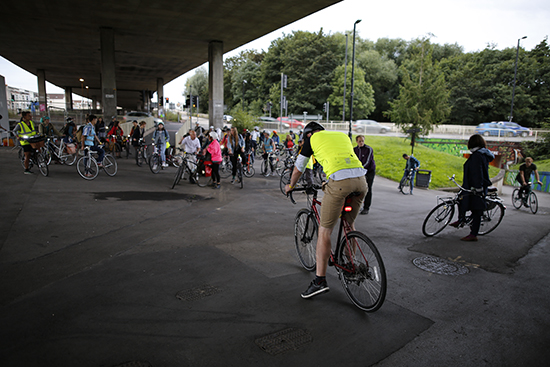
Art Spin at The Great Dying, Bristol Biennial 2016: In Other Worlds. Photo c/o RoserDiaz
First stop, Our Colour, by Manchester-based artist Liz West, a large, low-ceilinged and open plan office space suffused with a spectrum of colours. With this (according to the Biennial brochure) we were being asked, “Does colour change the way you feel?”. The venue choice of The Pithay highly suited the claustrophobic and dizzying array of lights on show and I was left to view the work in peace. Twenty minutes later, I was outside rummaging through the several layers of fellow participants bikes trying to find my own.
We cycled on, finding ourselves at The Great Dying, by Sydney-based artist Emily Parsons-Lord. This time the Biennial team asking “Have you tasted the air of another time?” After waiting for the petrol generator to start up, we entered a large wooden boxed room (painted white) in groups of ten. Constructed on Eastville Roundabout, one of Bristol’s most air-polluted areas, proved a good choice for opening up a conversation on air-pollution. However, being handed a questionnaire as soon as I exited and having two cameras documenting my every move, abruptly interrupted my experience and confirmed my initial feelings of a programme that has been overwhelmed with the need to tick boxes.
Getting dramatically darker, we reach Staple Hill Tunnel, the last stop of our tour, to witness A Galaxy of Stars, by Michaela Gleave, another Sydney-based artist (made with composer Amanda Cole and app developer/digital artist Warren Armstrong). Having been directed into the tunnel’s abyss, I start to feel like I’ve entered the performance too soon, as the 50 or so hooded Gurt Lush Choir performers finish one last rehearsal, before being told “This is it!”. Experiencing this event without possession of a smartphone was a misstep on my part, however I didn’t feel this hindered the spectacle.
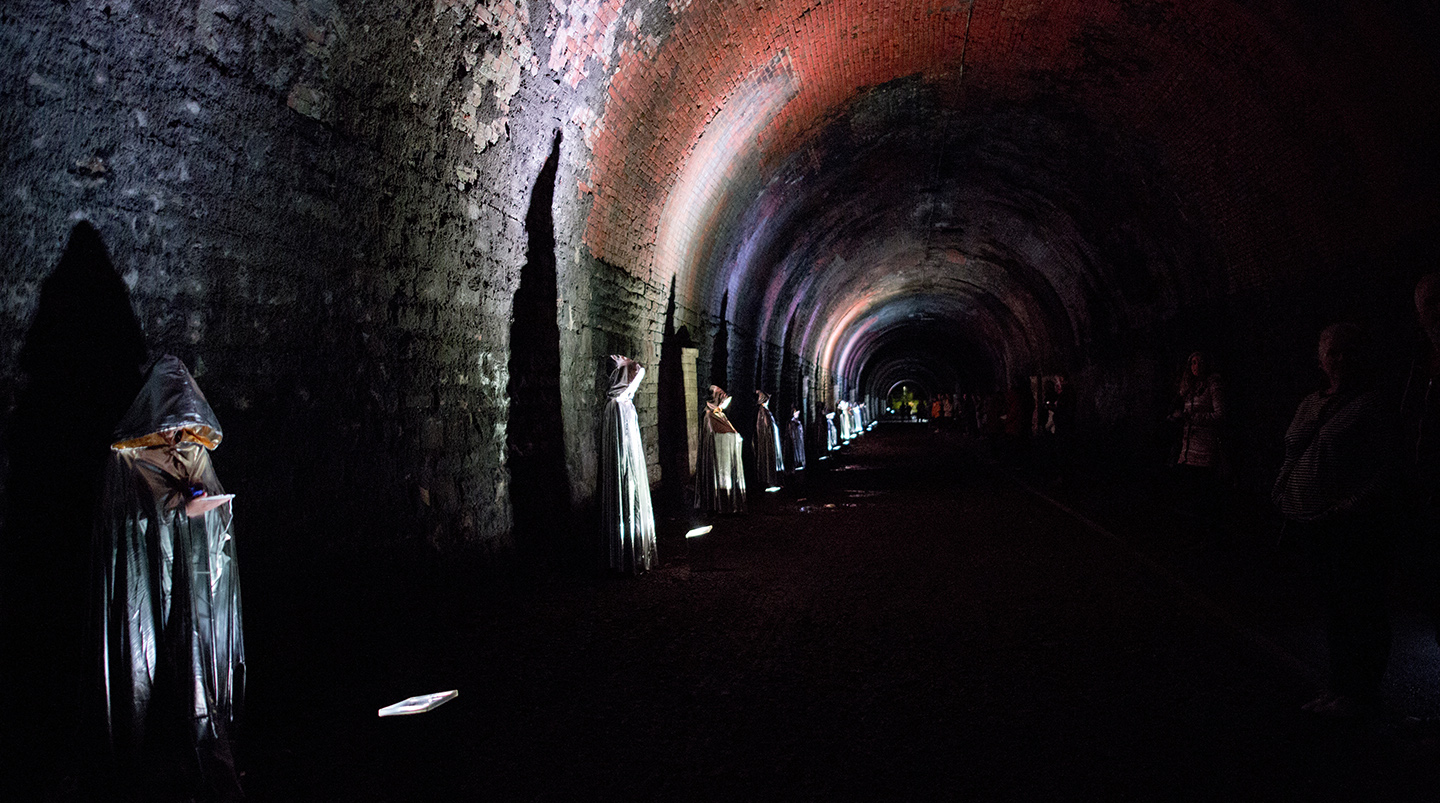
Galaxy of Suns by Michaela Gleave, Amanda Cole and Warren Armstrong, Bristol Biennial 2016: In Other Worlds. Photo c/o Roser Diaz
Browsing through this year’s programme, it appears the biennial team have been extremely eager to create an overtly accessible festival. This potential artistic ownership of “biennial” has succumbed heavily to fit funding criteria (the largest amount the festival has received since its first incarnation in 2012). This sounds blunt, considering the colossal amount of work involved with organising a project of this scale. However, it is difficult not to think like this, when Bristol is crying out for an innovative arts festival to match the success of those as globally and locally engaged as Glasgow International or Liverpool Biennial. I am aware it is just as difficult for these to break free of sponsors, but if there is an opportunity of seeing some genuinely inspiring work then I am sold.
Nootropics and the Last Frontier of (Un)consciousness
To begin her 'performance-lecture', Nina Stuhldreher sets the clubhouse mirror ball revolving. It's a kind of improvised wedding reception aesthetic replete with technical glitches, cash-only bar, and a speech that veers, mostly unintentionally, into cringey political incorrectitude. None of it quite manages to break through the academic insularity of the material – it cannot be presumed, as Stuhldreher suddenly realises, that the ₤3-paying Biennial crowd can be divided, like her usual audiences, into three types: 'scientists, artists, and theorists from the humanities' – but it audibly goes some way towards relaxing everyone.
Stuhldreher is 'a reality researcher who operates with artistic strategies'. 'Performance-lecture' is a misnomer insofar as Nootropics and the Last Frontier of (Un)consciousness apes the lecture-form most overtly in its use of PowerPoint. The quasi-diaristic performance recounts the development of Stuhldreher's artistic response, 2010–2016, to an initial research question, 'Where do metaphors come from?' This question prompts further research, documented (loosely) chronologically (”like a TedX talk without a topic” – anon.).
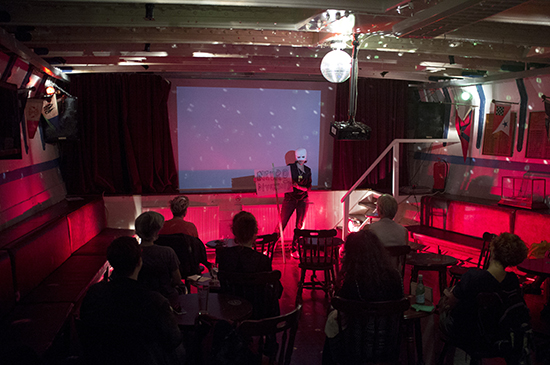
Nootropics and the Last Frontier of (Un)consciousness by Nina Stuhldreher, Bristol Biennial 2016: In Other Worlds. Photo c/o Roser Diaz
Especially important to this story is 2011, a year that was 'very pre-2012-ish' – meaning: portentous of imminent apocalypse. Her thread is the contemporaneous collective unconscious. Stuhldreher – along with those who brought down governments, burned down Carpetright, lost every penny or woke to the knowledge but not the sensation of radiation spreading through Japan – lived at that time in a state akin to madness. I, for one, find it hard to draw a line under those years.
What Stuhldreher is keen to show is the role of association, projection and serendipity in shaping each new research direction. This is not only the case for herself and fellow artists, but for cognition more generally. Einstein's purportedly kinaesthetic sense of relativity is invoked. But Stuhldreher's central example is the perplexing ubiquity of 'sexy' triangles in art/fashion during the years covered. By what mechanism of group-think, Stuhldreher asks, did these resonate with the tentscapes of Occupy (as well as those – though thankfully she leaves this point undeveloped out of a sensitivity she unfortunately doesn't consistently display – of the refugee crisis) and the modern proliferation of tectonic images 'from-above' depicting wave-form-like mountain ranges – quite different, she shows us, from traditional mountainscapes.

There is, Stuhldreher admits – black-humouredly – an indistinctness for her between becoming receptive to these associations and going crazy. One title-card ponders 'Schizophrenia as a research tool?'
Nootropics' theme recalls Marco Pasi's recent lectures. By leaving all this otherwise 'outsourced perception' in, Stuhldreher's talk breaks the academic 'taboo' on discussing the more 'esoteric' contributions to their practice which many artists will privately acknowledge. By contrast, art theorists today, we are told, at least in Germany, 'only want to talk about identity politics.'
What if 'life' were to 'get so close' to her that she could not go on with her artistic production, Stuhldreher wonders. But Stuhldreher's whole notion of artistic production seems to involve, quite likeably, keeping 'life' – cosmological destiny, law of statistical averages – at a distance just sufficient to enjoy it aesthetically. Her production echoes, in this regard, an earlier fascination with new modes of online creation/reception: the uneasy mixture of pleasure/terror in Nootropics is the same combination that accompanied, e.g. the crucially aestheticised Twitter substituting for every other news broadcaster.
In art's mirror, mastery of a political vocabulary can be a strategy for keeping life close while maintaining sufficient distance from enjoyment. Differing symptomatologies speak to the same basic block. No-one can take the measure of our times except by hourglass: if during periodic 'crises', our whole perspective gets momentarily stood on its head, in the following instant the sand is in our eyes and ears again.
The Great Dying
Like Emily Parsons-Lord, Aussie creator of minimalist installation The Great Dying, I'm no Bristolian. Wondering how on Google Earth to get to Eastville Roundabout, a blue blob confirms I'm on track so I turn to pondering climate change and extinction, which is obviously exactly what one should be doing en route to an installation about climate change and extinction.
Stapleton Road is long. Right now it feels even longer. Boarded up shops, takeaway boxes, crisp packets. I realise I haven't seen a woman for quite some time. The thing is, I don't know Bristol. Art and climate change are making me feel like a prick, so I whip out my phone and thumb dangerous areas Bristol, wondering if this makes me too middle class, too neurotic, too racist.
STAPLETON ROAD – THE MOST DANGEROUS ROAD IN BRITAIN.
My pace quickens to a strut.
Through the subway (can one really trust The Mirror online?), a white box sits upon the grassy kernel of a vast and clamorous roundabout. The wall blurb says something about dinosaurs going extinct because of declining oxygen levels and how mankind might go the same way too. A loose interpretation, perhaps, because I'm sweating and my ears hurt and I'm starting to spin out. I foist myself through the door.
The motorway, muffled. A white box on the inside, too. A single digital display on the wall tells me the oxygen level is 20.6. From what I recall of the wall blurb, this is bad. I attempt to initiate a deep inward contemplation of climate change. A woman stumbles through the door. She glances around, rolls her eyes, walks out. 20.5. The strip lighting wobbles.
It's a small world inside this box. With worryingly low oxygen levels. And out there, too. Do people on Stapleton Road stick mainly around Stapleton Road? What's the housing situation like round here? The unemployment rate? Is all this murder, raping, shooting stuff really true? And if I lived off Stapleton Road and fancied popping onto the roundabout for a bit of free art one Saturday, how would I feel?
Oh, thank goodness we came to this beautiful minimalist installation to be reminded, in case we'd forgotten, just how difficult it is to breathe jammed into our extortionately priced one bed flat mere snuggling distance from the M32! What a delight to be in this white box with no windows, international support and fancy tech, so I can spend my one and only day off contemplating the possibility of impending mass extinction!
I lurch outside, inhale, light up a cigarette. I'm beginning to get a sense of why people don't spend a whole lot of time thinking about climate change. A volunteer clocks me. Shall I explain what it's about? I half-nod. Dinosaurs, sensors, oxygen levels decreasing the longer you're in there, the more people there are in there. Is she suggesting that I should I have brought a friend?
She's waiting for me to speak, so I strive for something on point.
Yeah, whenever I'm in a city my snot turns, like, totally black.
Top image: Bearpit Banquet - Bristol Biennial 2016: In Other Worlds. Photo c/o Jose Vegas
Bristol Biennial 2016: In Other Worlds | Festival of Art and Ideas | 2-10 September 2016