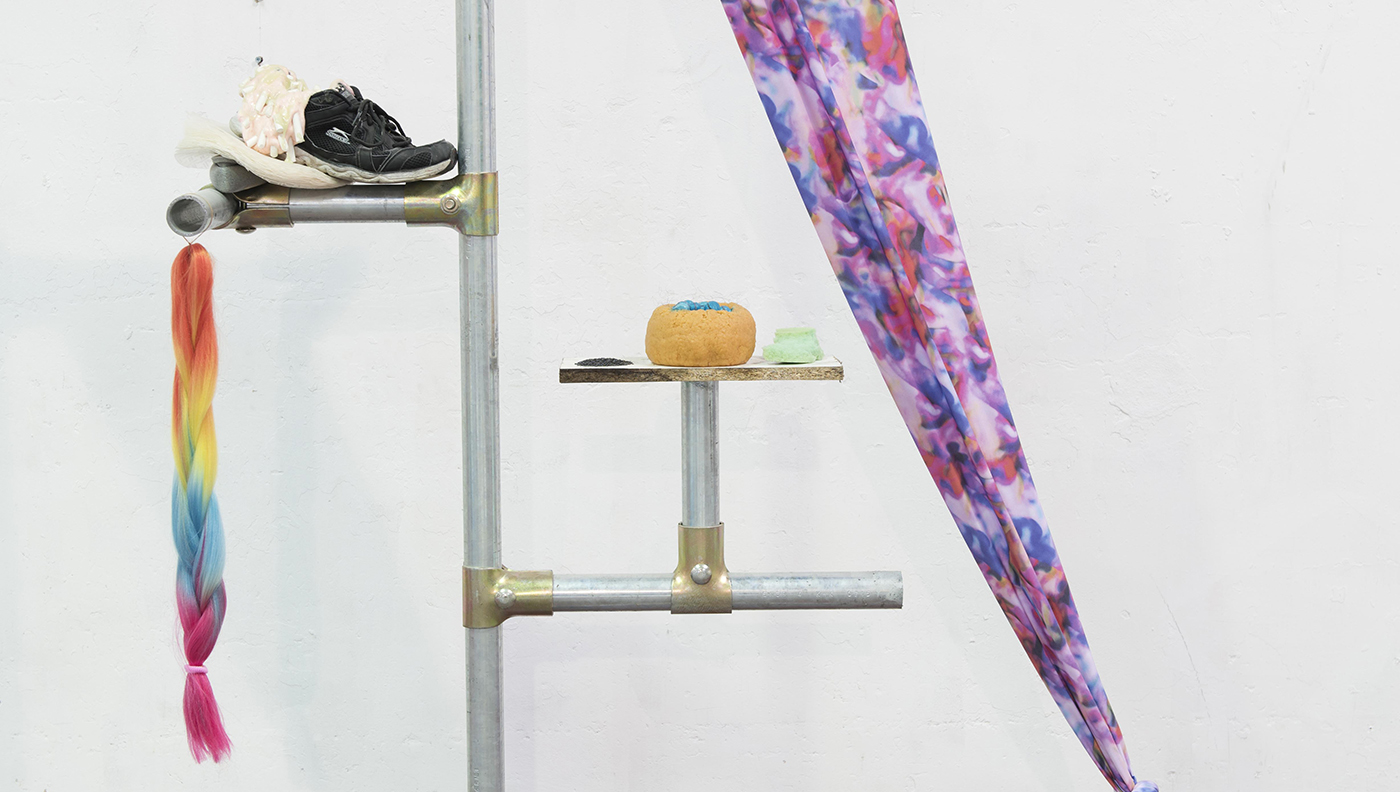
Eat Clean, scaffold, food stuffs, printed lycra, modified found and bought materials, 2015. Pangaea Sculptor’s Centre.
Matthew de Kersaint Giraudeau
Bad Vibes Club // Radio Anti // ARKA Group
Matthew de Kersaint Giraudeau is an artist based in London whose practice incorporates both individual and collaborative projects, including The ARKA Group with Ben Jeans Houghton, the research project Bad Vibes Club, and the occasional broadcasting project Radio Anti with Ross Jardine. Through conversations, emails and attending Bad Vibes Club events, I spoke to Matthew about his approach to autonomous group activity, the public abject temperament, and the utilisation of disgust, amongst other things.
Doggerland: On Radio 4 a couple months back was the report of a burglar killed by an alligator whilst evading the police in Florida. The 22-year-old man was drowned, and then eaten by an alligator. The headline came at the end of the reports, the slot often reserved for a lighter, unexpected turn of events, whether jovial, profound or bizarre. The moral implications were explicit, and I think what still resonates with me about this particular instance is a version of what you describe on the Bad Vibes Club website as Morbid Ethics. Could you expand upon your interests and theoretical approach to this term in your research?
That is a great example of morbid ethics bubbling away under the mainstream presentation of morality. It’s a morality tale; ‘don’t burgle houses otherwise you’ll get punished’, but it’s also enjoyable as a piece of news entertainment only because of the brutality of the punishment. Being eaten by a crocodile is not currently seen as an enlightened way to deal with criminality. It’s like a Brothers Grimm fairytale. It relates to the harsh, punitive justice of a time we might like to think we’ve left behind, but it’s unthinkingly presented as a fluff piece at the end of the news.
Morbid Ethics is a very open term. It’s deliberately ambiguous about what the aim or outcome of a morbid ethics might be. It could be something productive, for example our current research for Field Broadcast is an examination of interruption as an artistic practice. It could be critical; Jonathan P. Watts’ upcoming talk at Open School East is his take on the contemporary happiness industry. Or, it could be something more ambiguous, like Daniel Oliver’s upcoming performance lecture (05.10.16 at Open School East) will be both a talk about awkwardness, and a performance that uses and produces awkwardness. Morbid Ethics is on the one hand supposed to address serious concerns, for example a post-human ethics might be the only way to think about how we act in the face of human influenced climate change. But it is also meant to allow space for a more adolescent or perverse approach to theory - I know that I enjoy the dystopian aspects of a lot of philosophy that I read, and I’m pretty certain there aren’t many people reading Nick Land’s ‘Machinic Desire’ for practical tips on how to live a better life.
Alain de Botton wrote a book called ‘Religion for Atheists’ which was about how a secular society might pick and choose the best rituals and ethical outcomes of religious practices, while dispensing with all the perversity, guilt, shame, hypocrisy and irrationality. Morbid Ethics is the opposite of that. If The Bad Vibes Club did religion, we’d deal exclusively with the perversity, guilt, shame, hypocrisy and irrationality. They’re the best bits.
DL: I’m feeling your ‘vibes’ - how does this term describe both the Bad Vibes Club and crossovers with other aspects of your practice?
Vibes is actually a pretty useful word to describe this activity. I work in music, and I always find the word vibes very annoying, but in the context of this project, it refers to ‘affect’ - as in emotions and feelings in or between people, as well as object-oriented philosophy, where the notion of vibes can be thought of as a relation between things; a sort of humming between different levels of material agency.
Vibes is also what Matthew credits to Laurence Taylor, co-founder of Open School East and pro-viber, where Bad Vibes Club was originally devised - during the first associate programme year between 2013-14 - and where BVC still maintains an ongoing programme.
My practice has lots of different parts, or ways of operating. They all kind of crossover, but not explicitly. The closest part to the BVC is probably my individual practice in which I make sculptures, drawings, performances and films that address ideas of abjection, negative affective states and the ambiguities of language and objects. These interests also inform what I do with the ARKA Group (a sculptural collaborative practice with Ben Jeans Houghton) and Radio Anti (a temporary radio station I run with Ross Jardine), but there is less of a crossover in terms of what those collaborative practices produce.
DL: ‘ The Bad Vibes Club is a collaborative research project investigating Morbid Ethics and the productive possibilities of negative states’ – if each seminar is hinged upon this notion, or the content of the discussion is responsive to these ideas in some way, and an invited guest speaker talks about these concerns, where does the exchange dynamic of collaboration occur? Is it between yourself and the speaker, integrating your own artist research and interests with writers and artists you admire? Or is it between you and the fellow participants to the event? I imagine it’s both, but I’d like to hear your take on it. Is there a need for recurrent attendance in order to generate collaborative practice?
The way in which the BVC is collaborative has changed over the three years it’s been running. In the first year, I assembled a group through open application that came to all the lectures and all the reading groups, the idea being that through meeting over time we could really attack this idea of morbid ethics and negativity together. We did that, but it was hard work to administrate. I slowly realised that however collaborative the BVC was, it would always be my project, and other people would take part when it was of interest to them.
In the second year I loosened my absurdly tight grip on the project in a few ways: people came along to the lectures and reading groups they were interested in, and different people selected texts.
One of the first contributors to BVC was the prolific Mark Fisher, who revisioned a contemporary tracing of anti-vitalism in philosophy from Jean-François Lyotard to Nick Land in ‘Anti – Vital’. Other presentations and readings have included our pal Oliver Braid on ‘The Certainty of Insignificance’, Sally O’Reilly on ‘Ambiguity’, and Joanna Bourke on the history of rape from the 19th century.
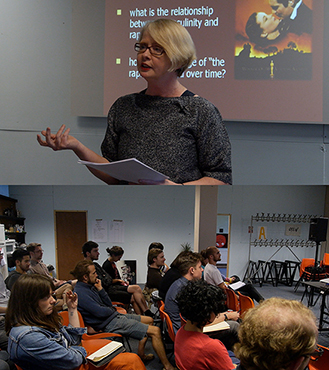
Bad Vibes Club: Joanna Bourke - “Why Are You Doing This To Me?” Sexual Violence in Nineteenth and Twentieth Century Britain and America, 2014. Open School East
But in other ways, I took ownership a bit more. The reading group is definitely collaborative in the sense that the main aim for each meeting is a group discussion and sharing knowledge, but I’m the only person who has to go to every meeting, and if no one else suggests a text, then I make that decision.
The BVC started producing research last year. I did a radio thing about the film Happiness with another BVC member called Matt Breen, a lecture at the ICA about loneliness, and as I mentioned, Sam Mercer and myself are doing a long-term research project called Interruptions, commissioned by Field Broadcast. I’m starting to see the BVC as three separate strands: the public programme, the reading group, and the research that we produce ourselves. They could all continue without the existence of the others, but they are all essential to The Bad Vibes Club.
DL:Talking about BVC when we met at Furtherfield you said how ‘…it’s still my project… but I have a real issue about participation and authorship ’… ‘… in any other situation, Bad Vibes Club would be the wrong way of doing something… ’. It was in the context of it operating simply as a mailing list, which, if the emails stopped, BVC would stop. You also questioned why anybody would want to claim authorship of the group. Can you clarify what you meant regarding democratic/curatorial authorship? Curated feels like the wrong word here…
Though the parts of The Bad Vibes Club I love most are when group discussion or collaboration produces new knowledge, my love for those parts is still my love, I can’t force other people to enjoy them as much as me, or be sure that everyone else feels the same way about them.
The BVC could be democratic, but I’d have to enforce that democracy. I’m less interested in making sure that everyone has input than I am in producing interesting stuff. A lot of that interesting stuff is collaborative and relies on shared interests and a democratic approach to managing group discussion, but the point of the BVC is not to perform democracy or group authorship. The subject matter, for me, is the most interesting bit.
The point about the mailing list was that no one else would want to take on the boring reality of administering the lecture programme or the reading group unless they were me! (Also, I sometimes find really good gifs and put them in the reading group emails, and I enjoy that.) Administration isn’t the worst thing in the world, it’s just a non-negotiable part of the project, which means that unless you are paying someone, you can’t expect them to take it on for you.
DL : Jamie Sutcliffe makes reference to Anna Lowenhaupt Tsing’s ‘The Mushroom at the End of the World’, in Art Monthly (394) to form part of his argument for alternative, nonhierarchical Anthropocenic global narratives. The source is cited as Tsing’s evidence into Matsutake mushroom ‘…leads her to reject notions of species self-containment and to proffer instead the idea of contamination as a vital form of collaboration…’. Contamination is regarded as a progressive action rather than a disruption. Radio Anti and BVC might be seen as contaminating the formulaic constructs of the formats each assimilates (seminars / broadcasting) by absorbing - but not adhering to - the mechanisms of public exchange (i.e. purposeful non-professionalisation, mostly accomplished by an inconsistency of occurrence or accessibility (Radio Anti is mostly off-air). Can you talk a little about the constructs of The Bad Vibes Club and Radio Anti that considers this notion of contaminating, and what this might produce amongst participants, speakers, listeners etc?
Maybe we should get Jamie to do a talk at The Bad Vibes Club! Contamination is definitely very bad vibes…
I think if the BVC has an aim by taking the form it does (a gmail mailing list, plastic chairs in a badly lit room, dates set by my personal calendar, accidentally programming in the summer holidays when no one is around etc etc), then it is more to do with the figure of the chip-on-their-shoulder autodidact, or the punk or DIY scene. The feeling is ‘who cares what it looks like?’ or ‘anyone can organise a research group’. But I dunno actually, even that is a bit much. The reason it takes the form that it does is because we are normally hosted by Open School East rather than a university, where these kinds of talks might otherwise take place. And Open School East is a very small, structurally light institution. To book the room I just put the date into a shared Google calendar. Sorry that is super boring. I would be happy to contaminate a university with The Bad Vibes Club! Perhaps in that situation, these ideas of democratic programming or structural lightness would feel more vital because I can imagine that in the modern university, there are many barriers to organising in that way. In the current situation, with our current budget, this is how we operate.
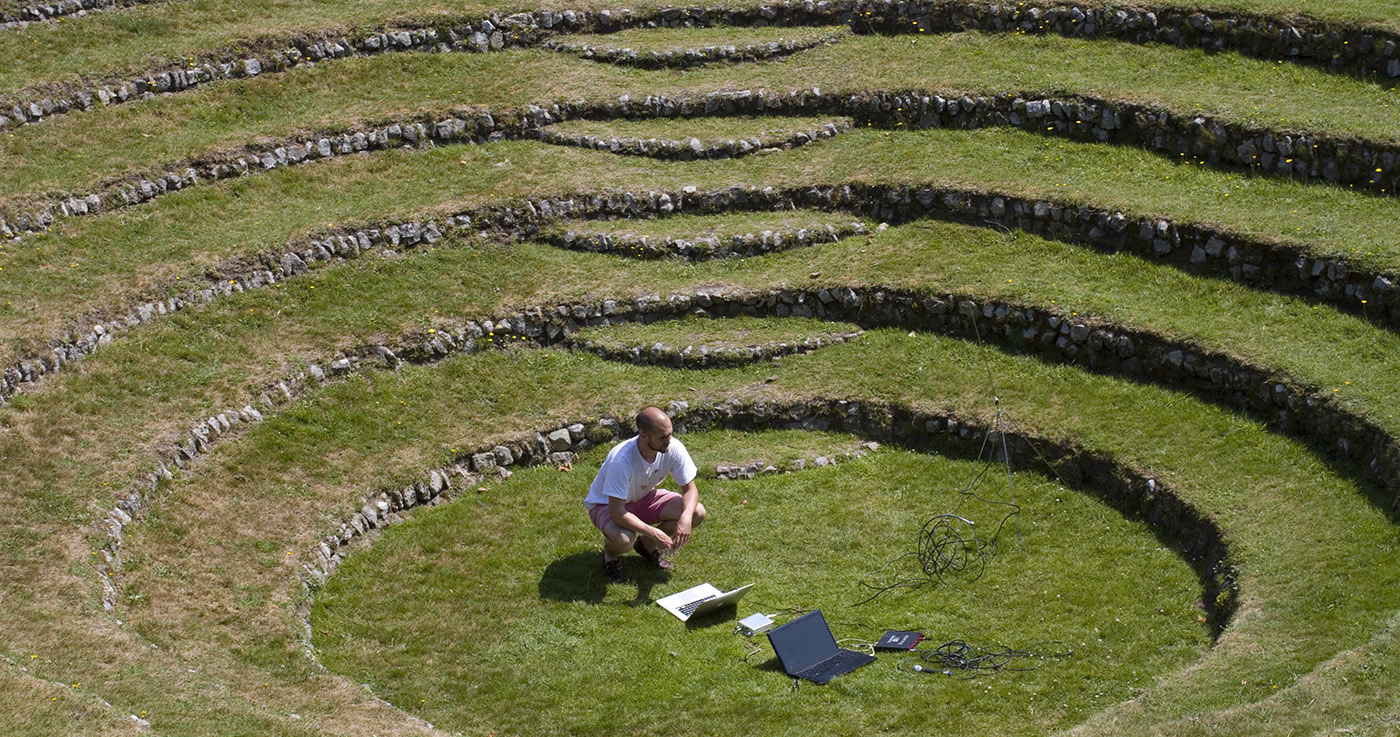
Gwennap Pit Transmission, Radio Anti, 2014
Radio Anti, on the other hand, was originally conceived as a radio station against radio stations. We construct the entire station every time we operate it. Our interests are in how a community of listeners is created, and we do that from scratch for each broadcast. We’re interested in the moment that things become clear: when Radio Anti changes from equipment in bags and boxes into a radio station. And, through our broadcasts, Radio Anti is becoming clear to us. What it can produce, and what form that it should take. We’re just about to start work on a short film. Maybe a year ago, this would not have been within our self-defined remit, but through our broadcasts with the Serpentine Gallery, we found that we had some things leftover from our research into foley sound and the production of imaginary space. Those leftovers seem like they’d be best used as material for a film.
DL : Contamination might also be seen as a productive negative state. Etymologically, the word is formed from the act to ‘make impure’, through contact, tangere - ‘to touch’. In some way, the concentrated areas of rubbish, referred to as ‘…a form of urban cholesterol, filling up the streets and slowing down the efficient liquidity of modern capitalism’, by George Vasey on your exhibition Votives, as The ARKA Group at Space in Between in 2015, are very literally a pollution of public space, land and atmosphere etc, but also a kind of ‘psychological index’, of mass production and consumption, byproduct, bodily affect and waste. Could you say that exhibition made a negative state productive, thinking both physically and mentally, and also individually and collectively?
Yes, George hit on something great with the idea that there are always things left behind; things that consumer capitalism would rather we forget. Many people talk or write about capitalism in terms of flows and efficiency, but what we experience more often is waste and abandoned things. For Votives, we collected material from the streets, but we also bought a lot of cheap materials: plastics and throwaway things from Poundland, unwanted decorative objects from charity shops, and DIY materials from B&Q. Ben and I think about these materials differently but when we come to make sculpture from them, we’re looking for a similar outcome. We want to get close to that uncanny moment when an object appears entirely unfamiliar. Jane Bennet talks about it in her lecture ‘Powers of the Hoard: Artistry and Agency in a World of Vibrant Matter’. For me, yes, I’m looking to bring something discarded back into view. I’m interested in the abjection of the materials, the in between state of not quite object, not quite subject. My reading of those materials that George describes so well as ‘urban cholesterol’, is not only as rubbish qua rubbish, but as things that are made and sold in the knowledge that they will be almost immediately discarded. They contain in their shiny, plastic surfaces, all the perverse desires that fuel consumer capitalism. Part of that desire is disgust, and my sculptural interest is in creating an aesthetic that contains and utilises that disgust.
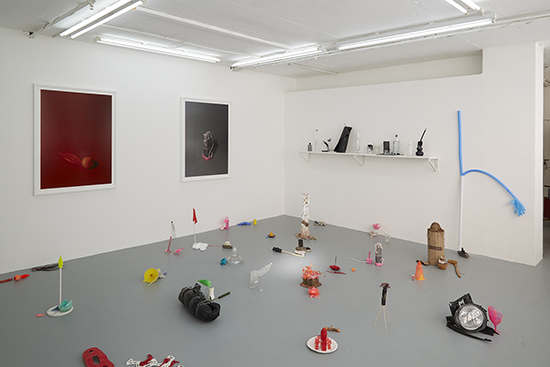
Votives, 2015. The ARKA Group. Image c/o The ARKA Group / Space in Between
I explicitly investigated this with a solo exhibition at Space in Between called Communal Juicing , using culturally abject foodstuffs (junk food, super strong alcohol, fizzy drinks) and bodily abject materials (pubic hair, vomit) to make sculptures that glistened and shone in the gallery lights, fascinating in their appearance, but repulsive too.
DL: Thinking back to the non-disruptive elements that constitute the act of contamination, in a Bad Vibes Club event at Furtherfield, Samuel Mercer made a clear distinction between disruption and interruption, to block, and to break respectively. Interruptions is a new collaborative research project from The Bad Vibes Club, in collaboration with Sam and commissioned by Field Broadcast. Can you talk about how this formed, and what the programme will involve in order to explore these ideas?
We’re trying to do a few things with the research. Firstly, we’re trying to create a (patchy) history of interruption as a practice used by artists and other practitioners (TV producers, advertisers, writers, theorists). Secondly, we’re trying to problematise interruption as a practice by looking at the figure of the interrupted subject, or how different kinds of interruption are available to different kinds of people. Thirdly, we’re trying to understand interruption as it is used now in a media landscape where interruption is the basic form of information packaging push notifications, auto-updating newsfeeds, multiple screens with different audiovisual notification systems etc. We’re writing essays online about different kinds of interruption - so far we have a video essay about the history of interruptive film and video practices in Britain (below), and an online essay about gifs, repetition and the death drive. We’re also putting up all of our research as we do it on a blog. We’re organising public events that examine different kinds of interruptions. (We’ve done an introduction to the project at LICA in Lancaster, and at Nottingham Trent University, we did a similar event at Furtherfield in London, an event about bodies and interruptions at MK Gallery in Milton Keynes, and in May we have an event at Open School East focusing on contemporary interruptive practices.) And, finally, me and Sam will be producing a new series of moving image works, informed by our research, that will be disseminated using the Field Broadcast software.
DL: Can you please extend upon the discussion we had about Swegways as a spatial interruption, which also becomes a politicised determination based on questions of class and race.
Swegway’s are an example of where interruption gets very bad vibes for me. What I want to explore with the gifs is the new, interruptive subject produced by the Swegway-body i.e., what kind of thing do you become when you get on a Swegway and ride it into a public space? One obvious answer is that you become a very annoying, interruptive thing. You move faster than a walking body, you take up more space, and are less predictable in your movements. On the swegway-body there are flashing lights and the swegway-body produces noise that is louder and different from a walking body.
Swegway-bodies are interruptive, and what’s more, it seems to me that (in South London, where I live and work, at least) the majority of those bodies are young working class men, or late adolescents. To a bourgeois subject, there might not appear to be anything emancipatory or even productive about the interruption that the Swegway-body produces. Let’s put it this way, I might be able to make a good enlightenment argument to my mum about why student protests are important, but I’d have a hard time constructing a similar argument about Swegways….
The British musician Dean Blunt has just released the album art for his latest project Babyfather. The image features a swegway with a British flag paint job, standing in front of the London skyline. In his solo projects Dean Blunt often meditates on the interruptive potential of the black male body, and - I think - his use of the swegway is part of that project.
The potential blackness of the Swegway-body is something I have started to address in a blog post, and it’s something worth considering because it gets back to this critical understanding of interruption - who gets to interrupt who, and what kinds of interruption are available to different kinds of bodies? The Swegway is an abject cultural object, rejected by bourgeois taste in order to define its boundaries of Otherness. The Swegway’s political interruptive potential is in its abjection, of that much I’m sure.
In conversation with Tom Prater