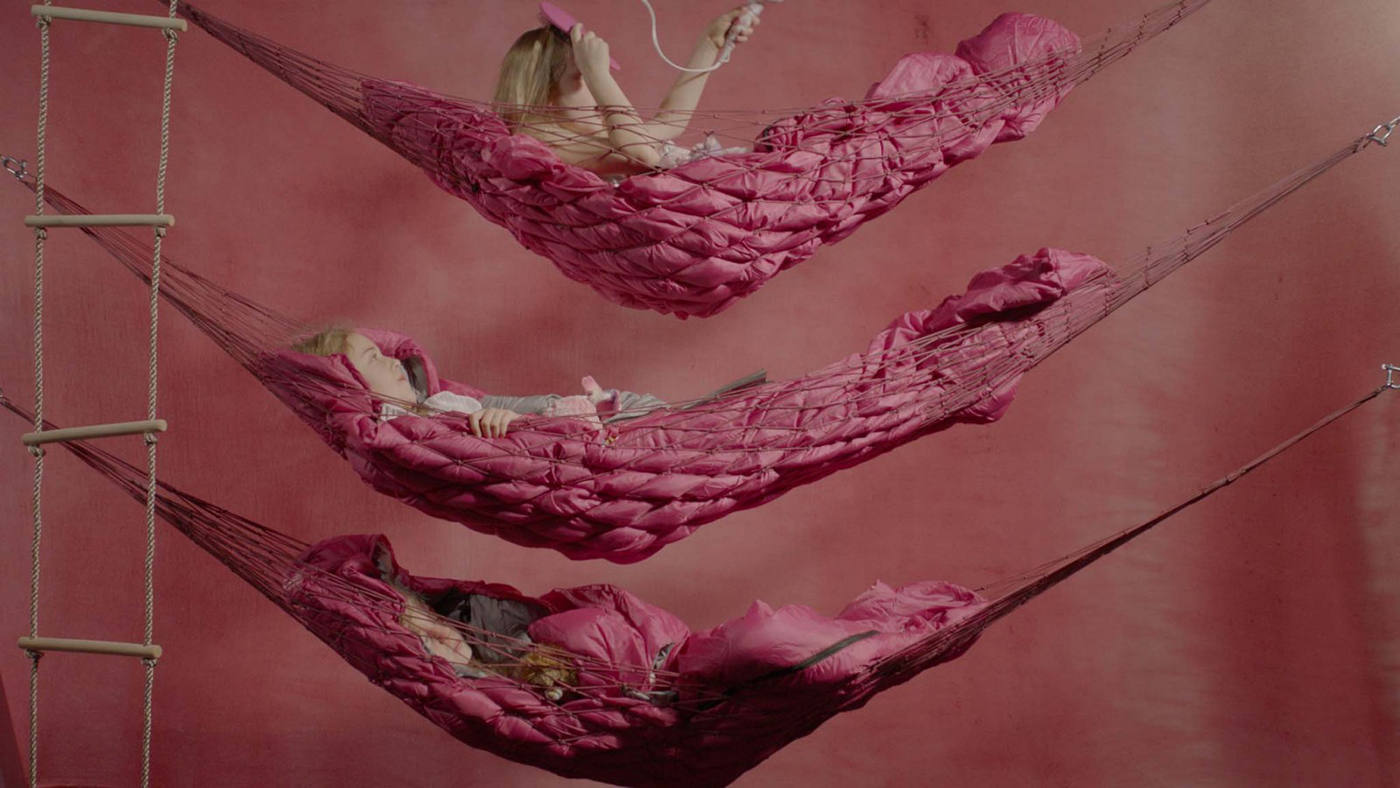
Blood, video still. Image courtesy of the artist
Blood, Marianna Simnett
What will they see of me?, Jerwood Space, London
Although not artist-led, nor independent as such, Film & Video Umbrella are a commissioning agency whose stated aim is “to capture something of the spirit of the moment”, and so works with relatively ‘emerging’ artists (though this term appears to be becoming increasingly meaningless in it’s catch-all capacity, hence the ‘relatively’). Featuring work commissioned by FVU, What will they see of me? ran between 11th March and 26th April at Jerwood Space in London, and comprised of new video works by Lucy Clout and Marianna Simnett. For the purposes of depth, time, and because it was the more engaging, ambitious and intriguing of the two pieces on show, we are going to focus attention on Marianna Simnett’s piece, Blood.
Simnett’s earlier companion piece, The Udder, felt like a compelling combination of subject, cinematography, set design, editing, sound, and dialogue - it was video with urgent vitality with regards to story-telling. The Udder riffed on the cows udder as a kind of indistinct prototypical protuberance morphing between nipple, finger, nose, and potential phallus, using numerous elements: beautifully designed sets of thin coloured fabric walls showing characters interacting between them, a young girl walking around a dairy farm, and shots and interviews with people working within. Everything in the piece worked towards the drive of the film, whilst feeling close to virtuosic in its handling of the material.
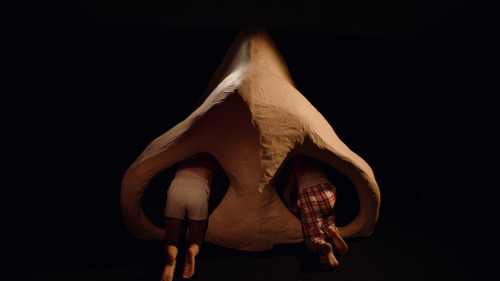
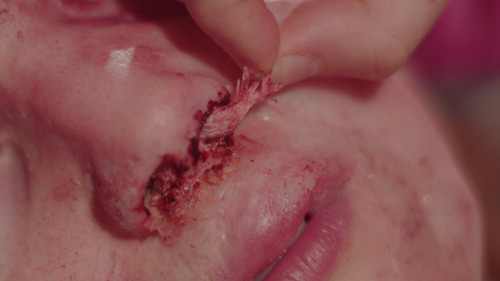
Simnett’s work at Jerwood very directly continues this earlier occupation with the latent morphability of the body, its connection with childhood, and in turn gender, framed around the removal of a particular bone from the nose, and the subsequent swelling and bruising of the face post-operation. The piece explores the anxiety of bodily growth and change in childhood through semi-realistic, squeam-inducing depictions of the nasal operation itself, song, dialogue (where the girl, Isabel, is chided by two other girls for her bodily difference, who at moments appear as her friends, imaginative embodiments of her own anxieties or dramatisations of her body itself) and, once again, sumptuous sculptural sets, this time coloured in bright body pinks.
Blood, video still. Image courtesy of the artist
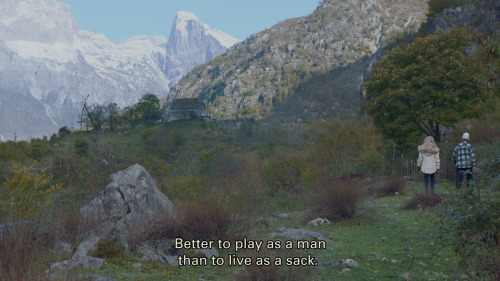
Alongside this thread, another aspect is played out and developed, born of Simnett’s research into the Albanian tradition of ‘sworn virgins’, a set of social codes formalised in the 15th Century, called the Kanun, whereby a woman swearing to remain a virgin for the entirety of her life may live, dress, work, socialise and inherit the same property rights as a man. The title, Blood, itself obliquely references the ‘blood oath’ of that culture which demanded the retribution of death in return for a man’s murder, but not necessarily that of a woman, exposing the grave value difference attributed to each sex, another aspect subverted by the sworn virgin’s ascension in all matters to exactly the status of the man. This thread is played out in the piece largely through fictionalised interactions between an adult sworn virgin, Lali, and the child Isabel, set amidst a rural mountainous region of Albania. In a particularly neat scene Isabel sleep walks repeatedly into the side of Lali’s bed, causing Lali to, in turn, repeatedly give her a short fireman’s lift back to her own bed: a sweet, suggestively paternal gesture.
Blood, video still. Image courtesy of the artist
A small girl no older than 10, Isabel appears to wear bright red lipstick throughout the piece, similarly potentially highlighting (though in a quite distinct way) her difference to Lali, a child overtly performing femininity or adulthood, in a comparably malleable and performative way to that of the sworn-virgin. However, although the title, and in their various means the two threads mentioned, reference the bond between inner and outer, between the body and the social bonds encasing it, or at times, in a manner of speaking, freeing it, the potential for interaction and cross-fertilisation between Isabel’s nose operation and the subject of sworn virgins could have been developed and woven together with a clearer sense of the two distinct sections shared potent. That there are overlaps is clear enough, and I don’t begrudge the work required to make them, but rather that it felt their poetic potential for overlapping wasn’t exploited, or perhaps didn’t feel that fully developed.
Blood, video still. Image courtesy of the artist
The notion of the sworn-virgin is a fascinating one to be introduced to by the subject of Simnett’s video, of a transgender tradition with a quasi-religious code to it as a socially-defined means of overcoming the strict traditions detailing the limited legal and social rights of women. We see a group of people in a rural Albanian home setting, conversation flowing, food and drink being shared, and get a sense of community, of the embedded nature of this tradition, sitting within, rather than outside, of the social fabric of the area. Unlike the other women in this setting, the sworn-virgin Lali sits, is accepted, and appears to fit seamlessly into the male spaces of this community. Interestingly, knowing Lali is a sworn-virgin, the gender of everyone in the room became unsettled and open to doubt, the presence of this one person unhinging the gender binary of everyone in the scene. This in itself would have been an incredibly engaging subject, and not inherently just for a documentary setting. The fictionalising approach of Simnett in this work, if expanded on, given more space, could possibly have opened up both the particularity of this world and some of the ‘life-as-lived’ of being a sworn virgin, but it felt like it was introduced as a metaphorical notion purely to expand on the ‘nose’ segment, and so, perhaps as a result, got a lot less screen time than it felt like it deserved. It could easily also have asked of Isabel some questions as to her own feelings towards gender, instead of using her as a foil of sorts to enter the Albanian community.
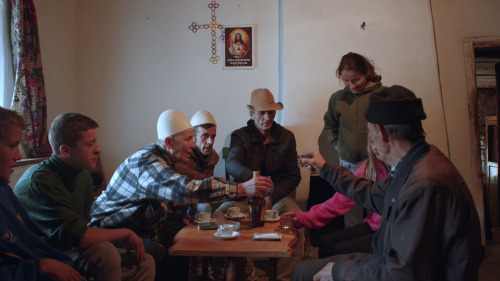
Blood, video still. Image courtesy of the artist
On her use of non-actors, Simnett says: “There is something magical about asking someone to play the part of themselves. It’s harder in a good way – no-one wants to be seen or scrutinised for who they actually are, so I embed their identities back into a fictional zone, to camouflage the real. I think it is about rejecting interchangeability. These people are the only ones who could possibly fill the role, because the role is born from them.” This goes someway to explaining her use of Lali, an actual sworn-virgin, to play the part of guide or inductor, introducing Isabel into their community and way of life. Instead of hearing an interview with Lali detailing Lali’s life and choices, we hear inferences told through performed exchanges between Lali and Isabel, however this aspect of re-performance contained none of the tension such a premise might suggest, and instead felt somewhat uninvolved. I got no sense that Lali cared for her role, there was no impression of what might be at stake in Lali’s decision to become a sworn virgin, other than a singular mention of the Kanun aphorism: “A woman is a sack made to endure”. This ‘camouflaging of the real’ could be exactly why the role doesn’t quite seem to gel, and could of course be exactly the point, bringing to the fore the awkwardness associated to any form of performing, especially on camera; but again, if this was the case it felt like more could have been made of it, some slippage between the real and the performed, for example. Again, in some ways it felt like Lali is also a foil for Isabel’s own journey of growth and becoming, and so we have a foil for a foil, Isabel and Lali as stand-ins for latent ideas.
In some ways, the work felt like it would have been a great deal stronger by just focusing on one of the two elements. There was so much in the ‘nose’ section of worth - the incredible sets, the ‘musical’ number, the touchingly poignant dialogues, to name but a few - that had it been on it’s own, left to breathe (pun unintended), then the ideas of childhood, bodily and mental growth, and becoming would have been more than absorbing enough. As it was it just felt torn, and unsure of where it wanted to focus my attention, of what exactly the work was trying to communicate to me (which is of course, quite equally, a potential failing of my own). In the same way, a work exploring the Albanian community, the notion of the sworn-virgin, of the malleability of gender, could have been equally absorbing given its own space. Either that, or, and this may seem an unfair criticism given the masochistic implications for its production and budgetary demands, the work could easily have been longer, and thus teased out the connections between the two subjects, giving both the space they deserve whilst at the same time letting the poetic potential of their co-habitation coalesce into something more distinct.
Samuel Playford-Greenwell



